A black opal with rolling green fire can cost more than a used car. A convincing synthetic with almost the same look can cost less than dinner for two. That gap is where most opal buying mistakes happen, and almost all of them are avoidable with a loupe, a few direct questions and a bit of patience.
Nobody expects you to become a gemmologist in an afternoon. What you can do is learn where natural opal usually gives itself away, what synthetic and assembled material tends to look like up close, and which phrases on a receipt should make you slow down. Most of this takes five minutes at the counter.
Start With the Words, Not the Stone
Before you fall in love with the colours, ask one plain question: what exactly is this? Solid natural opal, boulder opal, a doublet, a triplet, a synthetic, or an imitation? A professional seller answers without flinching. A seller who drifts into adjectives instead of nouns is telling you something useful.
The vocabulary is worth memorising, because it is the cheapest test you will ever run:
- Solid opal — a single piece of natural opal, cut and polished. This is what most buyers think they are purchasing.
- Boulder opal — natural opal still attached to its ironstone host rock. Genuine, and usually obvious from the brown stone backing.
- Doublet and triplet — a thin slice of natural opal glued to a backing, sometimes with a clear cap on top. Real opal, but not a solid stone.
- Synthetic or created opal — opal-like silica grown in a laboratory, with the same basic chemistry as natural opal but none of its history.
- Imitation — glass, resin, plastic, or a printed foil designed to mimic play-of-colour. Not opal at all.
Get that word in writing on the invoice or the listing. "Created opal", "lab-grown opal", "opalite", "assembled" and "treated" all mean something specific, and none of them mean solid natural opal. If a listing describes a stone for three paragraphs and never once uses the word "solid", treat that as an answer rather than an oversight.
Play-of-Colour: The Clues Nature Leaves Behind
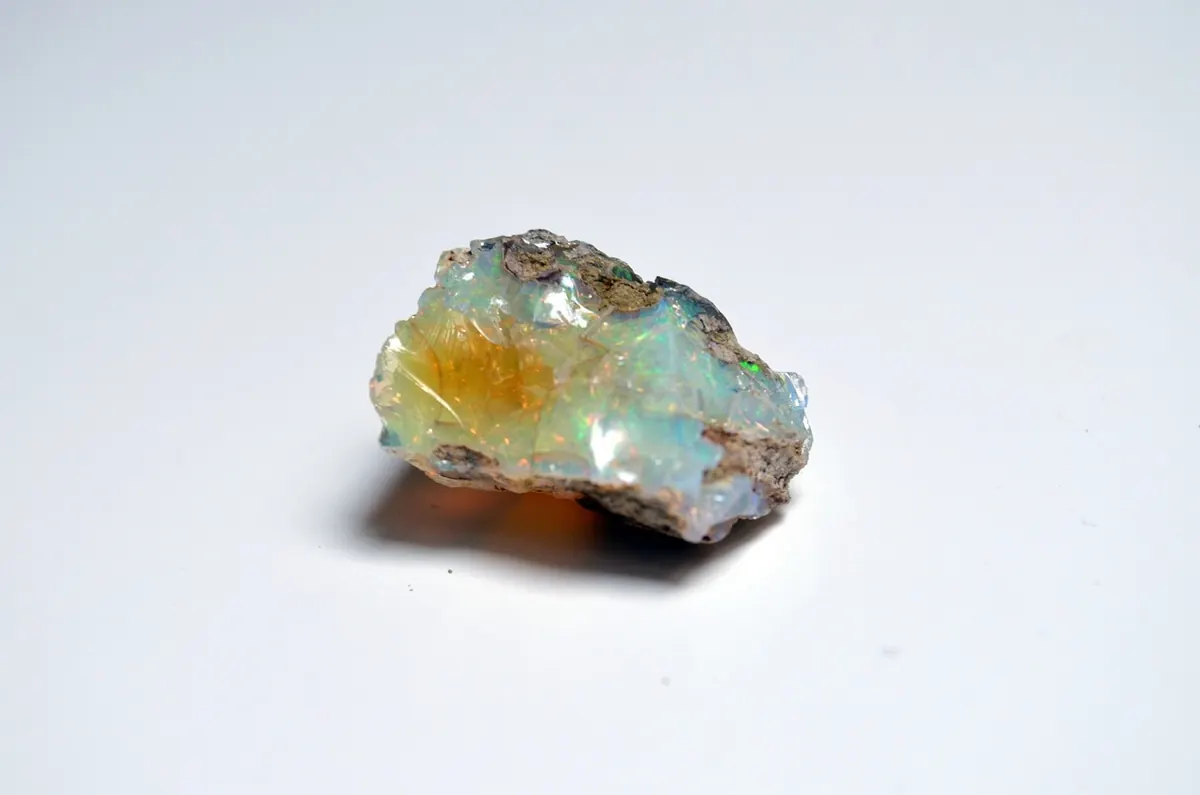
Natural opal gets its fire from millions of tiny silica spheres stacked in irregular layers. Light diffracts through those layers, and because the stacking is never perfect, the resulting colour is never perfect either. Patches of green sit next to patches of blue at slightly different depths. Edges of colour are a little ragged. Some parts of the stone flash brilliantly while others stay quiet. That unevenness is not a flaw; it is the fingerprint of formation.
Synthetic opal is built by depositing silica spheres in controlled layers, and control leaves traces. Under a 10x loupe, look for colour arranged in straight columns, regular rows or a repeating scaly texture that resembles lizard skin. Look for a face where every patch of colour is equally bright and evenly spaced, as if printed. Look for a large stone with absolutely no dead zones — no potch, no quiet corners, no interruption in the pattern at all.
None of these is a verdict on its own. Skilled manufacturers have narrowed the gap considerably, and a good synthetic can fool an experienced eye in a photograph. But regularity should make you look harder rather than reach for your wallet. Also remember that natural opal sometimes crazes, and so does synthetic material, so fine surface cracks tell you about care and storage rather than origin.
Look at the Edge, Not the Face
The single most useful habit in opal buying is turning the stone sideways. A solid opal is one continuous piece from top to bottom. A doublet or triplet is a sandwich, and sandwiches have seams.
With a loupe and a bright light, examine the side profile. A thin, perfectly straight line running parallel to the face is a glue line. On a doublet, the opal slice on top is often remarkably thin, and the backing below may be black potch, ironstone, or something less romantic. On a triplet, you will usually see a clear cap sitting above the colour layer, with the seam visible beneath it. Triplets often have a flat, glassy, mirror-smooth top that feels different from polished opal.
Doublets and triplets are legitimate, useful and affordable. Plenty of people wear them happily for years. The problem is only when one is sold as a solid stone, or priced like one. Two related cautions: glued assemblies dislike long soaking and ultrasonic cleaners, and a suspiciously convincing black backing on a cheap "black opal" deserves a very close look at the join.
Glass, Resin and the Imitations That Aren't Opal
Glass imitations, including the material sold as "opalite", tend to give themselves away through their colour rather than their surface. The fire looks suspended — flakes, sequins or threads held inside a milky or clear base — rather than generated from within the stone. Boundaries between colours are often sharp and flat. Under magnification you may find tiny round bubbles, and the base material frequently looks too even, as though poured.
Resin and plastic imitations feel different in the hand: warmer than stone, noticeably light for their size, and easy to scratch with a fingernail in an inconspicuous spot. Some show a printed or foil layer with a repeating pattern that becomes obvious when you rotate the stone and the colours fail to move the way you expect. Glass, by contrast, feels heavier than an opal of the same size, because it is denser.
Please skip the folk tests. Hot needles, knives, lighters and household chemicals damage real stones and prove very little. A loupe, a light and a side view will tell you more, and they leave the stone intact.
A Short Checklist Before Money Changes Hands
- Ask, in writing, whether the stone is solid natural opal, and get the answer in the listing, invoice or receipt.
- Request a short video in daylight, with the stone rotating. Static photos hide everything that matters.
- Ask for a clear photograph of the side profile. Refusal is informative.
- Check the return policy and the window for returns. Buyers who can send a stone back tend to make better decisions.
- Be sceptical of black opal and crystal opal at prices far below what that material normally commands. Natural black opal is genuinely scarce.
- Pay by a method that offers buyer protection, and keep the correspondence.
One more tip for markets and fairs: ask to see the stone under natural daylight, not just the dealer's lamp. Opal changes character between lighting conditions, and a stone that sings under a warm bulb can look flat at the window.
When Certainty Is Worth Paying For
For anything beyond a modest purchase, take the stone to an independent gemmologist or appraiser before the return window closes. A short written opinion confirming that a stone is solid natural opal, with the treatment or assembly noted if there is any, costs very little compared with the price of a good black opal — and it settles the question in minutes. Ask specifically for identification and for disclosure of any treatment, doublet or triplet construction.
This is general guidance rather than a substitute for professional assessment of a particular stone, and it matters most at the higher end of the market. For an inexpensive pendant or a pair of earrings, the loupe, the side view and a straight answer from the seller will usually take you far enough.
Buy the stone you can see clearly, from someone willing to describe it plainly, at a price that makes sense for what it actually is. Natural opal is strange, uneven and unrepeatable, and that is precisely why it is worth the extra five minutes of checking.
Photo: Henning_W / Pixabay