Set four opals side by side on a dealer's tray and the difference is clear within seconds. One glows from a milky white base, one looks like a shard of night sky, one still has brown ironstone clinging to its edge, and one seems lit from somewhere behind the stone. All four are opal. The names that separate them describe three things: the colour of the stone's body, the ground where it formed, and the way it was cut. Those three details shape everything else, from how the colour behaves in daylight to how the stone should be set and stored.
Body Tone: The Distinction That Explains the Rest
Before the labels make sense, separate two things that beginners often blend together. The body tone is the background colour of the stone when you hold it away from direct light. The play-of-colour is the moving flash of green, red, blue, or orange that appears when you tilt it. A pale stone can carry spectacular fire, and a very dark stone can be almost quiet.
The Australian opal trade describes body tone on a scale from N1, the darkest, to N9, the lightest. Brightness is graded separately, usually from 1 to 5. This is why a "black" opal is rarely jet black; look closely and you will usually see deep grey, navy, bottle green, or a near-black brown. Pattern names matter too. Harlequin looks like a mosaic of angular tiles, broad flash covers large areas at once, and pinfire scatters like a fine spray. Two stones of the same weight and body tone can differ in value simply because one pattern is rarer and more evenly spread.
White Opal: The Accessible Classic
White opal, also called light opal, sits on a milky, porcelain, or pale grey body. Coober Pedy in South Australia is the name most people associate with it, and for good reason: the town has produced enormous quantities of light opal for over a century. The play-of-colour tends to appear as soft flashes and pinfire, with greens and pinks especially common and reds less so.
For a first purchase, white opal is hard to beat. You get real, natural play-of-colour at a fraction of what a comparable black opal would cost, and a 7mm round cabochon makes a lovely pendant or pair of earrings. Judge it in indirect daylight rather than under a shop spotlight, and check that the colour appears across the whole face, not only in one corner. A white opal whose fire goes dull at arm's length will look flat once it leaves the display case.
Black Opal: Small, Dark, and Coveted
Black opal is defined by body tone, not by the colour of its fire. The trade generally treats N1 to N4 as black opal, with N5 and N6 called dark opal. Lightning Ridge in New South Wales is the benchmark source, and Mintabie has produced notable dark material as well.
The dark background is doing real work. It absorbs stray light and pushes the play-of-colour forward, so greens look greener and reds look hotter than they would on a pale base. This is why black opal is the rarest and generally the most expensive form, and why collectors will pay serious money for a stone only five or six millimetres across. If you are buying one, ask the seller for the body tone and brightness grade in writing, then take the stone to a window. Fluorescent showroom lighting flatters every opal; a north-facing window does not.
Boulder Opal: Character Cut From Ironstone
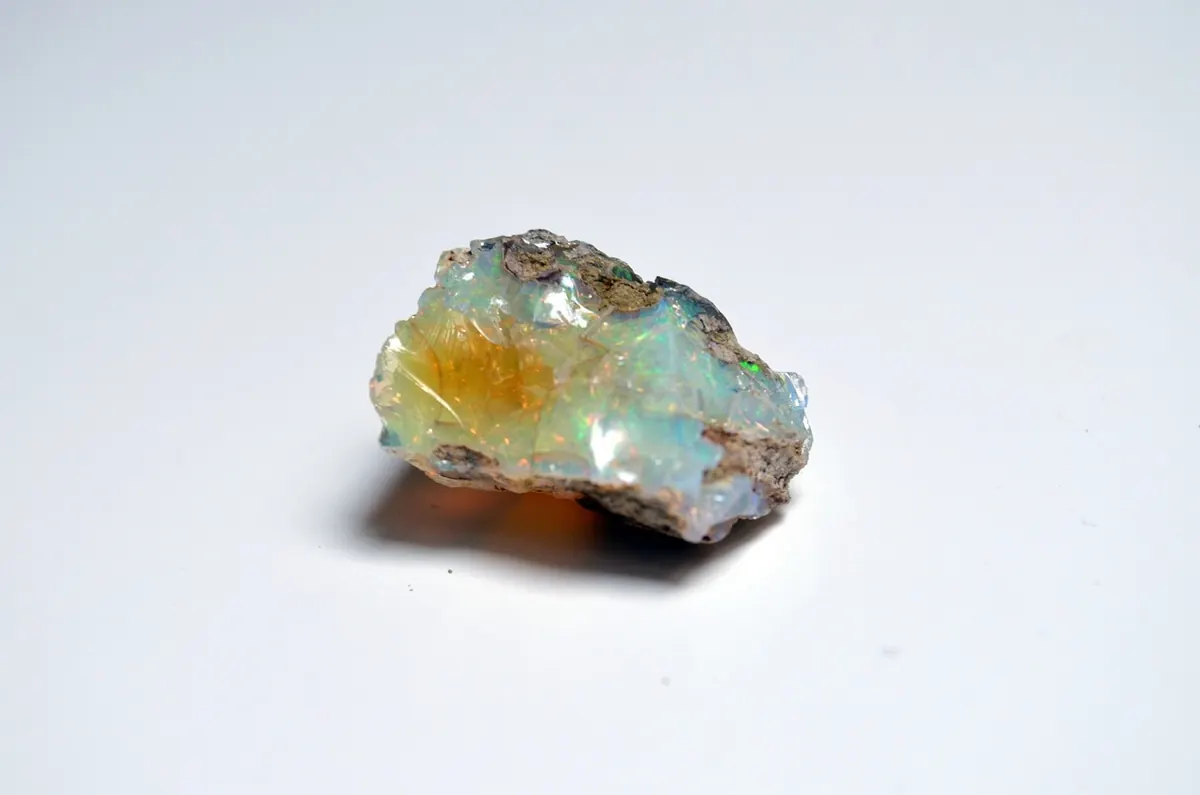
Boulder opal forms in thin seams and small pockets inside ironstone concretions in western Queensland, around places such as Quilpie, Winton, and Koroit. Because the opal is so thin, the cutter leaves the natural ironstone attached as a backing, and often as a rim. The result is a freeform cabochon with an organic outline that no two stones share.
That ironstone is not a flaw; it is structural support. Boulder opal is the toughest of the precious types, which makes it the sensible choice for a ring you intend to wear constantly. A dark brown or black host rock also acts like a dark backing, intensifying the colour of the seam. Note that this does not make the stone a black opal in the grading sense, and it is not priced as one. Two related products are worth knowing: boulder matrix, where small flecks of colour are scattered through the ironstone, and Andamooka matrix, which is routinely treated to darken the porous host rock. Always ask whether a matrix stone has been treated.
Crystal Opal: Transparency With Fire
Crystal opal has a transparent to semi-transparent body, so the play-of-colour appears to float inside the stone rather than sitting on its surface. Light crystal opal has a pale or colourless base and comes from fields including Coober Pedy and Andamooka. Dark crystal, transparent but with a dark body, is rarer and prized by collectors for its depth.
Because you can see into a crystal opal, the setting changes everything. A closed silver back, a black backing, or an open bezel will each give the same stone a different mood, so ask to see it held against a few backgrounds before you commit. Clean transparency also means flaws show up readily, which is useful. Crystal opal is sometimes faceted, though most is cut as a low cabochon. Ethiopian Welo opal falls into this family and is often hydrophane, meaning it can absorb water and briefly change transparency and colour; keep it out of the ultrasonic cleaner and take it off before swimming.
Which Type Suits Which Buyer
- A first piece, worn often: white opal in a bezel-set pendant, or boulder opal in a ring.
- Maximum colour on a small stone: a black opal of 4 to 6mm beats a larger, paler stone for impact.
- Everyday rings: boulder opal, or a well-made triplet if the budget is tight.
- Collectors: black opal with an even harlequin or broad-flash pattern, dark crystal, and patterned Koroit boulder.
- Design-led buyers: freeform boulder and Yowah nut opals, where the shape is part of the appeal.
- Careful budgets: light crystal and white opal give the most colour per unit of spend.
Buying and Caring for Any Opal Type
Whatever the label, the same checks apply. View the stone in daylight, front and back, and turn it through every angle. Ask directly whether it is solid, a doublet, or a triplet, and get any treatment disclosed in writing. Opal ranks roughly 5.5 to 6.5 on the Mohs hardness scale, so it scratches and chips more easily than sapphire or diamond; skip ultrasonic and steam cleaners, avoid sudden temperature swings, and store pieces separately in a soft pouch.
Reserve your highest spend for the type you actually intend to wear, not the one that sounds most impressive. A boulder opal ring you reach for every morning will give you more pleasure than a black opal locked in a drawer. For any purchase that is significant to your finances, ask for an independent valuation and treat it as you would any other considered investment.
Photo: Dieter444 / Pixabay